
Published March 26, 2026
Thinking About Subdividing Land in Elbert County? Here’s How the Minor Subdivision Process Works

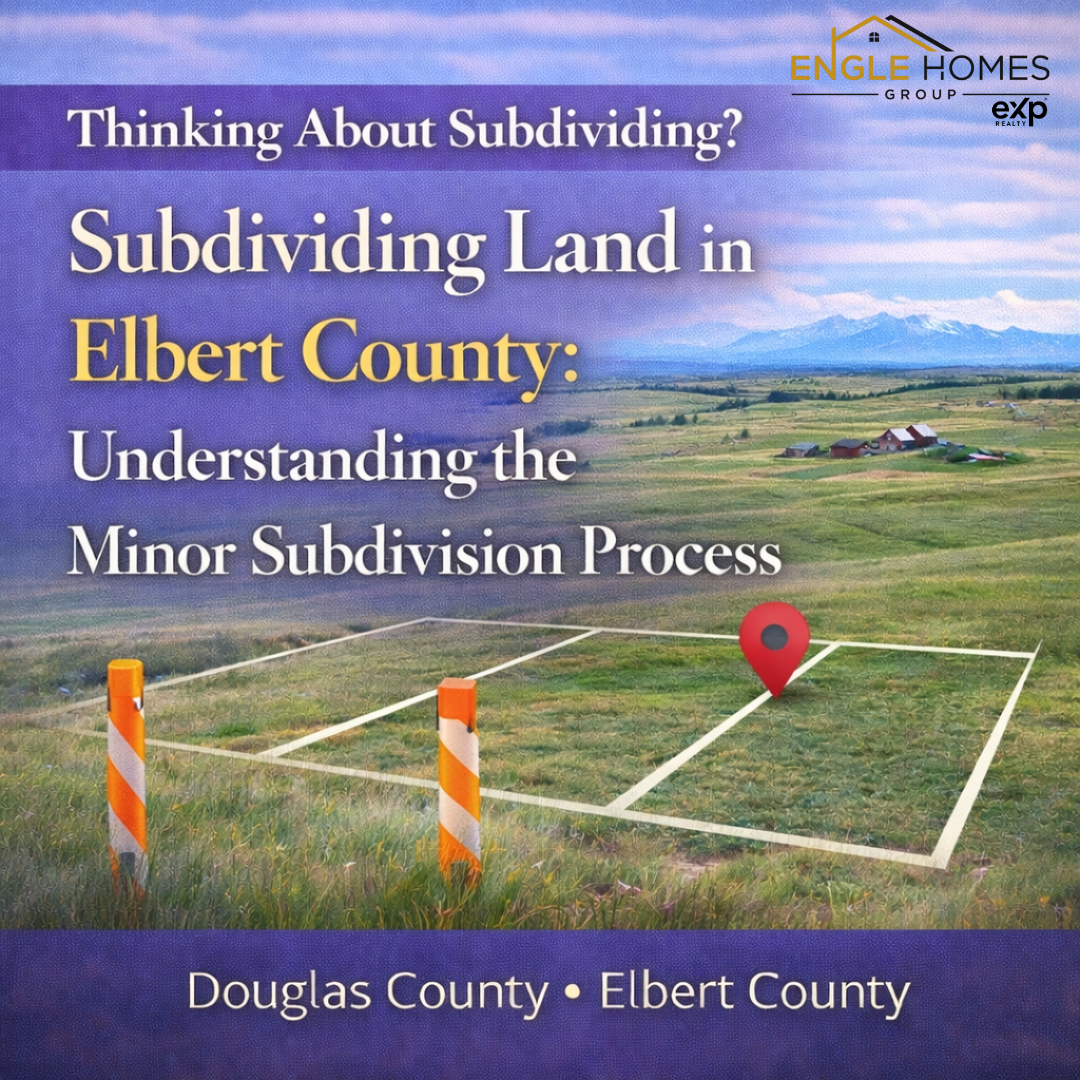
Thinking About Subdividing Land in Elbert County? Here’s How the Minor Subdivision Process Works
- Many landowners in Elbert County eventually ask the same question:
“Can I split my land and sell part of it?”
The answer is often yes — but it requires following the Elbert County Minor Subdivision process.
Whether you're holding 35 acres, inherited land, or rural property near the Douglas County line, understanding the subdivision process is essential before making plans.
Here’s how it works.
What Is a Minor Subdivision in Elbert County?
- A Minor Subdivision allows landowners to divide an existing parcel into a small number of new lots without going through a full major development process.
In Elbert County, this typically applies when:
- A property owner wants to divide a parcel into 2–4 lots
- The property already meets minimum acreage requirements
- Infrastructure demands remain limited
The process is designed for rural landowners rather than large developers.
Minimum Lot Size Requirements
- Elbert County zoning plays a major role in determining whether subdivision is possible.
Many properties fall under zoning categories such as:
- A – Agricultural
- RA – Rural Residential
In many areas, the minimum lot size is 35 acres, but zoning, overlays, and prior land divisions can change what is allowed.
Before planning a subdivision, property owners should verify zoning through the Elbert County Planning Department.
Step 1: Pre-Application Meeting
- The process typically begins with a pre-application meeting with Elbert County Planning.
During this stage:
- Staff reviews the property
- Zoning and subdivision eligibility are confirmed
- Potential road, access, and utility concerns are discussed
This step helps determine whether a minor subdivision is feasible.
Step 2: Hire a Land Surveyor
A licensed Colorado surveyor is required to:
- Establish property boundaries
- Create the proposed lot layout
- Identify easements and access points
- Prepare the official plat map
Survey costs vary depending on acreage and complexity.
Step 3: Address Access and Infrastructure
Subdivision approval often depends on infrastructure considerations such as:
- Road access
- Easements
- Utility access
- Drainage considerations
If parcels will rely on wells and septic systems, spacing and environmental regulations must be reviewed.
Step 4: Submit Minor Subdivision Application
- Once the survey and planning are complete, the application is submitted to Elbert County.
The application typically includes:
- Subdivision plat
- Legal descriptions
- Access documentation
- Utility planning
- Review fees
County staff then begins formal review.
Step 5: County Review and Public Process
Elbert County departments review the proposal for:
- Zoning compliance
- Access and safety
- Environmental considerations
- Infrastructure impact
Depending on the proposal, the subdivision may go before the Planning Commission or county staff review process.
Step 6: Final Approval and Recording
- If approved, the subdivision plat is recorded with the county.
At that point:
- New legal parcels are created
- Each lot can potentially be sold separately
- Property boundaries become official
Only after recording can parcels legally transfer independently.
Why Many Landowners Subdivide
In Elbert County, subdivision can unlock value by:
- Selling smaller parcels individually
- Creating family parcels
- Increasing overall land value
- Preparing property for future development
However, not every parcel qualifies, and the process requires planning.
How Elbert County Compares to Douglas County
- If you're comparing nearby Douglas County, subdivision regulations tend to be stricter there due to suburban density and infrastructure requirements.
- Elbert County’s rural zoning often provides more flexibility for acreage properties.
Subdividing land in Elbert County through a Minor Subdivision can be a powerful way to create additional value — but the process requires careful planning, surveys, and county approval.
Understanding zoning, access, and infrastructure requirements early can save time and prevent costly mistakes.
For landowners considering subdivision, working with professionals familiar with rural property transactions is critical.
If you have questions about subdividing land, zoning requirements, acreage pricing, or selling rural property in Elbert or Douglas County, I’m happy to walk through the full picture so you can make a confident decision.
Marjorie Engle – Realtor
📞 303-881-2707
🌐 www.marjorieengle.com

Marjorie Engle
| Engle Homes Group | eXp Realty
or another way