
Published July 7, 2026
The “Ag Status” Loophole: How Agricultural Classification Can Dramatically Lower Colorado Property Taxes

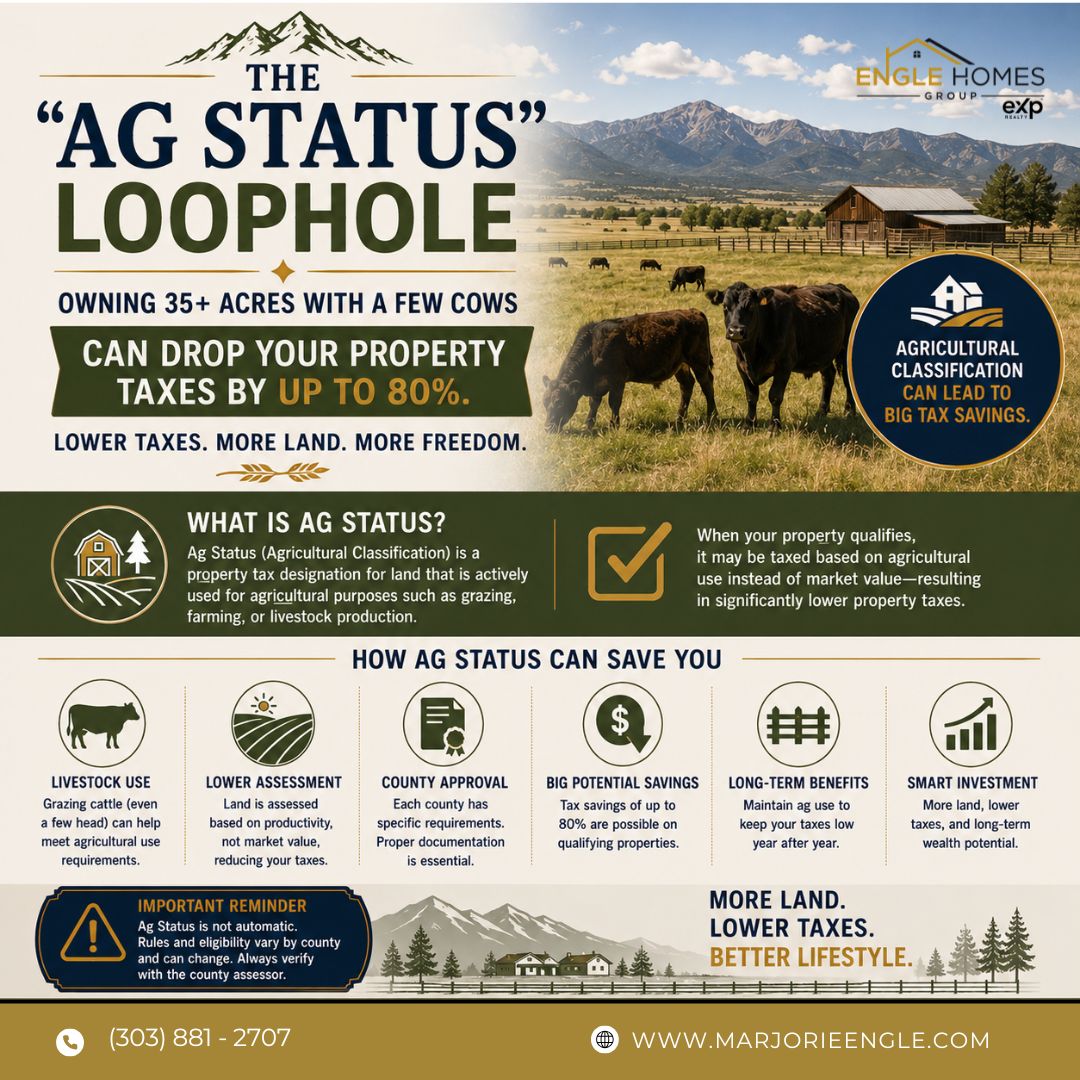
The “Ag Status” Loophole: How Agricultural Classification Can Dramatically Lower Colorado Property Taxes
One of the biggest surprises for buyers looking at acreage in Elbert County is this:
- 👉 Some large rural properties pay dramatically lower property taxes than nearby residential homes.
Why?
Because of:
- 👉 Agricultural classification, often called “Ag Status.”
In Colorado, qualifying agricultural land may be taxed VERY differently than standard residential property—and in some situations, property taxes can be significantly reduced.
For acreage buyers, this becomes one of the most important things to understand before purchasing land.
What Is “Ag Status” in Colorado?
Agricultural classification is a property tax classification used for land that is actively being used for:
- ✔ Livestock grazing
- ✔ Farming
- ✔ Agricultural production
Instead of being taxed purely as residential land.
Why Property Taxes Can Be Much Lower
Residential land is typically taxed based on:
- 👉 Market value.
But agricultural land may be assessed differently based on:
- ✔ Agricultural productivity
- ✔ Grazing capability
- ✔ Agricultural use formulas
That difference can create:
- 👉 Major property tax savings.
Why Buyers Talk About the “35-Acre Rule”
In Colorado acreage communities, buyers often hear:
- 👉 “35 acres.”
That’s because:
- ✔ 35-acre parcels are common in rural areas
- ✔ Some county zoning rules reference 35-acre divisions
- ✔ Many agricultural properties happen to fall into that acreage range
However:
- ⚠️ Simply owning 35 acres does NOT automatically create agricultural classification.
Livestock Often Plays a Role
Some agricultural classifications involve:
- ✔ Cattle grazing
- ✔ Horses in certain circumstances
- ✔ Hay production
- ✔ Agricultural leases
This is why buyers sometimes hear:
- 👉 “A few cows can help maintain ag status.”
But the actual requirements can be much more specific than people realize.
Agricultural Classification Is NOT Automatic
- This is VERY important.
To qualify for agricultural classification, counties generally evaluate:
- ✔ Actual agricultural use
- ✔ History of production
- ✔ Grazing activity
- ✔ Documentation
- ✔ Income or lease structures in some cases
Every property situation is different.
Elbert County Has Many Agricultural Properties
Because Elbert County has:
- ✔ Large acreage parcels
- ✔ Ranch land
- ✔ Grazing property
- ✔ Rural zoning
Agricultural classification discussions are extremely common during real estate transactions.
Douglas County Has Fewer True Ag Properties
- In Douglas County, suburban growth has reduced the number of traditional agricultural parcels.
However, some western and rural sections of Douglas County still contain:
- ✔ Ranch land
- ✔ Large acreage
- ✔ Agricultural classifications
Buyers Should NEVER Assume Taxes Will Stay the Same
One of the biggest mistakes acreage buyers make is:
- 👉 Assuming the current tax rate automatically transfers.
Agricultural classification can sometimes change because of:
- Ownership changes
- Use changes
- County reassessment
- Grazing agreements ending
- Development activity
Agricultural Leases Are Common
Some property owners maintain agricultural classification through:
- ✔ Grazing leases
- ✔ Hay production agreements
- ✔ Agricultural partnerships
This is common throughout rural Colorado.
Colorado Water & Land Use Matter Too
Agricultural properties may also involve:
- ✔ Water rights
- ✔ Grazing rights
- ✔ Fencing responsibilities
- ✔ Agricultural infrastructure
Which makes acreage ownership very different from suburban homeownership.
Why Buyers Love Ag-Status Properties
Many buyers are attracted to agricultural land because of:
- ✔ Lower taxes in some situations
- ✔ Larger acreage
- ✔ Ranch lifestyle
- ✔ Open space
- ✔ Privacy
- ✔ Long-term land value potential
Common Relocation Misconceptions
People moving from out of state often assume:
- “Ag status” is automatic
- Any acreage qualifies
- One animal is enough
- Taxes never change
But Colorado agricultural classifications can be highly specific and county-dependent.
Why Due Diligence Is Critical
Before purchasing acreage property, buyers should ALWAYS verify:
- ✔ Current classification
- ✔ County requirements
- ✔ Tax history
- ✔ Agricultural use documentation
- ✔ Long-term eligibility
Because future tax changes can significantly impact ownership costs.
Why Elbert County Continues Attracting Acreage Buyers
Elbert County remains extremely popular because it offers:
- ✔ Larger land parcels
- ✔ Rural lifestyle
- ✔ Horse properties
- ✔ Ranch opportunities
- ✔ More freedom and privacy
Compared to many suburban areas near Denver.
Important Disclaimer
- Property tax laws and agricultural classifications can change and vary by county.
Buyers should always verify:
- ✔ Current county requirements
- ✔ Tax assessments
- ✔ Agricultural qualification standards
With the county assessor and qualified professionals before purchasing.
Agricultural classification can dramatically reduce property taxes on qualifying Colorado acreage properties.
But:
- 👉 Owning land alone is not enough.
Actual agricultural use, county requirements, and long-term qualification rules all matter when evaluating ag-status property in Douglas and Elbert County.
If you’re thinking about buying acreage in Colorado, exploring ranch properties, or learning how agricultural classification impacts land ownership in Douglas or Elbert County, I’d love to help guide you through the process.
Marjorie Engle – Realtor
📞 303-881-2707
🌐 www.marjorieengle.com

Marjorie Engle
| Engle Homes Group | eXp Realty
or another way